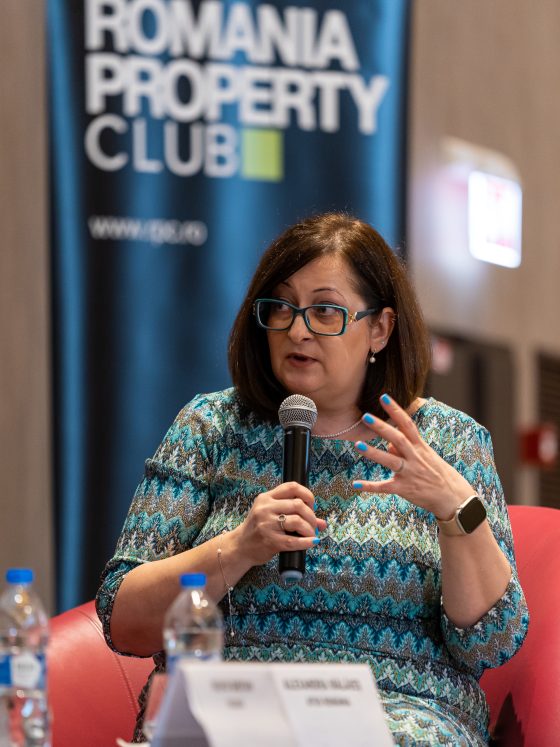
RPC Talks with Alexandra Mălăieș
Facility Manager, Atos Romania
Company Profile
Atos has entered the Romanian IT market in July 2011 and operates in Timisoara, Bucharest and Braşov and employs more than 2400 people.
Timișoara was the main core and the first major delivery center acquired and expanded by Atos in 2011. What are the advantages of Timișoara for a multinational entering the Romanian market?
For Atos, Timișoara has always been the heart of our business in Romania. From the very beginning, the local community proved to offer real and significant growth potential: a valuable pool of students and professionals, exceptional language skills, and two universities with which we have built strong partnerships.
At the same time, the city has grown and developed alongside us. Today, Timișoara is no longer just a major hub for economic development, but also a city with an increasingly visible diplomatic life. We see this through the eyes of our clients as well – when they visit us, they are impressed by the city and the variety of events they discover here. For them, all of this reinforces confidence in a business that operates within a stable and dynamic environment.
Another advantage is the balance between operational costs and the conditions Timișoara provides. We have a top-quality office here that we are truly proud of. When we decided to build in Timișoara, it also mattered that 10 years ago we were the first client – the anchor client – of United Business Center 1, part of what was then Openville, now Iulius Town.
You have been part of the Atos team for 10 years, managing the company’s real estate department across operations in four cities: Timișoara, Bucharest, Cluj-Napoca, and Brașov. How do people relate to the workspace in these four cities, and what differences have you noticed?
Even before the pandemic, Atos offered flexibility for working from home – around 20% of employees worked permanently outside the office. Today, this flexibility has become the norm. However, commuting conditions in each city play a big role in office attendance. In Bucharest, commutes take a long time. Cluj is becoming increasingly congested – if 10 years ago you could cross the city in 40 minutes, today you can easily spend an hour to an hour and a half in traffic for the same distance. Brașov is a relatively small city, and our colleagues enjoy going to the office to meet with their teams more frequently. Timișoara houses our main headquarters, where we regularly host client visits. Colleagues come in to meet with clients as well as with their team members. Essentially, the office has become a gathering place for teams and clients, as well as a space where colleagues reconnect with company values.
Ways of working have undergone many changes since the pandemic. What working model currently applies at Atos, and how do you utilize office space today – do private offices or open spaces prevail, and how much space is dedicated to employee well-being?
At Atos, we work flexibly, and the working model can vary from team to team based on the nature of their activity and specific client requirements. For example, we have clients who, for security reasons, require activities to be conducted from a specially designated space. We feature open-plan areas, secured zones, meeting rooms, and a generous, flexible space designed for gatherings and events.
For us, employee well-being translates into very concrete amenities: well-equipped kitchens, coffee, and fresh fruit. We also organize events where we encourage colleagues to participate, welcoming them with treats and small surprises.
What do your employees expect from their work environment? We know the office now competes with working from home. What tips the scales in favor of coming to the office – services, amenities, comfort, or community?
Employees want a “wow” office – a space where they feel good. We love seeing colleagues pleasantly surprised on their first visit, or clients impressed by the building and workspace. Proximity amenities are just as important. It’s easier to choose to come to the office when, after work, you can catch a movie, go to a restaurant, or do some shopping. That’s why the location of our offices is crucial and contributes directly to employee experience and satisfaction.
How does a company going through a global transformation with a local footprint reconfigure its real estate strategy? How do you adapt the space to these changes, and what are your plans for the coming years regarding the offices you occupy?
The Atos group strategy is firmly focused on growth in the coming years, and our offices must be prepared to support this evolution. We remain flexible so we can adapt space to various client requirements, supported by our landlord. We have just completed a complex transformation of an entire floor, and we are glad to be able to respond to these requests seamlessly.
We are also fortunate to have a furniture supplier that understands our needs and finds solutions to keep the office as flexible as possible. In fact, we have been using the same high-quality furniture for 9 years without needing major upgrades. We aim to use our resources efficiently, finding smart solutions to reorganize space based on current needs. We perform targeted refreshes in specific areas, but so far, radical changes haven’t been necessary.
How do we measure office efficiency?
I believe that in business, we need to talk more frequently about how we measure space efficiency. Traditional indicators like occupancy rates or square meters per desk are no longer sufficient.
Today, a proper evaluation of an office’s utility can be achieved, for instance, by incorporating workplace-related questions into employee engagement and satisfaction surveys.
The office must actively promote company values while fostering human interaction and team cohesion. In my view, these are the key metrics to evaluate whether an office truly adds value.
For example, we can measure how colleagues interact or the level of team cohesion after a period of regular in-person collaboration. Such indicators give us a much clearer picture of the value the workspace delivers to the business.