“In 2024, we anticipate an increase in demand for housing units, supported by the general need for new quality homes as the majority part of the actual stock is outdated nationwide.“
With over three decades of experience in the hospitality industry and real-estate, Tinu has occupied various high-level management positions. During this time, he successfully executed numerous impactful projects, leaving a significant imprint on the industry. As CEO of IMPACT Developer & Contractor, Tinu Sebesanu is determined to increase the company’s worth by placing a strong emphasis on sustainability principles throughout the development of all projects.
Top 3 trends you foresee in 2024 for the real estate market?
In 2024, we anticipate an increase in demand for housing units, supported by the general need for new quality homes as the majority part of the actual stock is outdated nationwide. The accessibility was declining the last 2 years due to the high costs of mortgage financing, but the anticipated decrease of interest rates and expected wages growth can bounce back the solvable demand.
While the construction costs had increased and several changes in tax incentives for the industry and other regulations had come in force, recently a surge in construction prices is observed. In Bucharest, to these factors influencing the future increase in new dwellings prices we need to add the envisaged downfall of supply for the next 5 years due to the lack of new zoning plans and consequently the issuance of new permits.
At the same time, the decrease in affordability will cause an increase in demand for the rental market, fueled also by the shift of preference of the new generations towards flexibility, debt aversion and accessibility, which brings new opportunities for investors seeking a fixed income and attractive yields.
“Retail market will continue its development, being the single sector which can offer short term yields of over 12%“
Cristian Simon has over 19 years’ worth of experience in the real estate brokerage industry and is the founder and managing partner of Simon, Iuga & Partners Real Estate Advisors, a company from Cluj-Napoca, with a presence in Bucharest as well.
Top 3 trends you foresee in 2024 for the real estate market?
Retail market will continue its development, being the single sector which can offer short term yields of over 12%
Residential market will suffer a contraction in terms of new deliveries, generating an impact towards price sales. We will probably witness a decrease in prices for od homes towards Q3.
Industrial sector is expected to stagnate with no significant deliveries, but we will se an upward trend for rents. We will see some interesting relocations generated by PSI standard updates.
Office market is expected to have a similar evolution as in 2023, landlords are the ones who will have to come towards tenants with new incentives for contracts extension.
Main challenges and opportunities in 2024?
Troubled times will bring new challenges, which agents will have to face. We will create opportunities by using other players’ lack of attention from.
What are your company’s business targets in 2024?
We continue to focus on developing the skills of our team members, also looking for new colleagues to join.
Romanian Airports Growth: 25 million passengers in 2023https://romaniapropertyclub.ro/wp-content/uploads/2024/01/Aeroport-Iasi.jpg20461293ROMANIA PROPERTY CLUBROMANIA PROPERTY CLUBhttps://romaniapropertyclub.ro/wp-content/uploads/2024/01/Aeroport-Iasi.jpg
The Romanian Airports Association announced that nearly 25 million passengers were recorded at Romanian airports throughout the last year, marking a significant milestone by remarkable pre-pandemic levels.
IasiAirport
According to the association’s data, the figures for 2023 revealed a remarkable 17% increase compared to 2022 and an impressive nearly 6% rise over the numbers recorded in 2019 (23,234.580 people). David Ciceo, the president of the Romanian Airports Association, expressed optimism, highlighting that air traffic across Europe is expected to reach 2019 levels by the end of the current year.
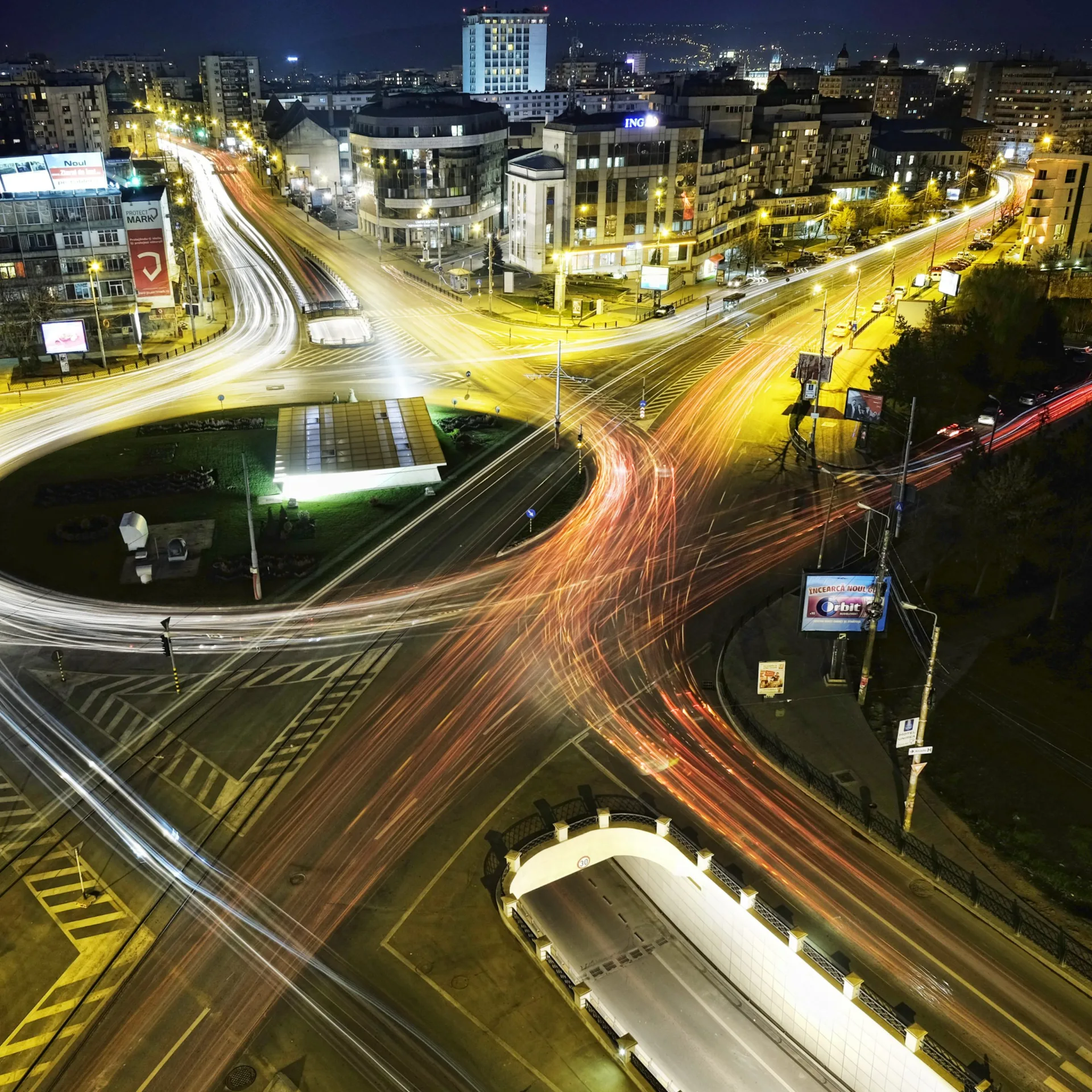
In Iasi, authorities recently inaugurated a new terminal, following a historic year with a traffic of 2.3 million passengers, making it the third most transited Romanian city, after Bucharest and Cluj-Napoca.
The aviation sector in Romania experienced contrasting trends in 2023. The total number of aircraft landings and take-offs saw a robust 5.6% increase, reaching 233,027, showcasing the resilience of the industry. In contrast, air cargo traffic witnessed a 5.7% decline, with 50,786 tons transported, down from 53,877 in 2022. Despite the decrease in cargo activity, the spotlight remained on the significant rebound in passenger traffic, emphasizing the sector’s overall adaptability and recovery.
Ciceo attributed the passenger rebound to substantial investments in airport infrastructure, including new terminals, expansions, and modernizations. Expressing optimism, he stated, “We expect traffic values to grow steadily, and we estimate that in 2040, Romanian airports will exceed 50 million passengers.” This positive trajectory highlights the resilience of the Romanian aviation sector in overcoming challenges.
Residential market still weak in offers for Romania’s third cityhttps://romaniapropertyclub.ro/wp-content/uploads/2024/01/ROMANIA_PROPERTY_CLUB_IASI_REZIDENTIAL-scaled.jpg25602560ROMANIA PROPERTY CLUBROMANIA PROPERTY CLUBhttps://romaniapropertyclub.ro/wp-content/uploads/2024/01/ROMANIA_PROPERTY_CLUB_IASI_REZIDENTIAL-scaled.jpg
Iasi represents Romania’s third city in terms of population, with strong local universities that nurture over 55,000 students annually. With those figures, the city is still weak in terms of new, modern housing units.
Iasi
Data collected by RPC from imobiliare.ro show that offers for the first three quarters in 2023 total 1,275 apartments, of which the new units listed count for 410, a minus of 18% as compared to the same period of the previous year.
The two major new residential projects in Iasi are developed by investors with national track record: Impact Developer & Contractor and Prime Kapital. Impact obtained the building permit for a major scheme totaling 1,062 apartments on Copou hill. Prime Kapital is developing a mixed-use scheme on the former Teba industrial platform. The new project has an important residential component, totaling 1,549 apartments to be delivered in different stages of construction. The first stage should be delivered by year end according to previous announcements from the developer, while construction for the second phase is underway. Each construction phase comprises approximately 300 units.
In terms of demand for both new and old units the figures for the third trimester show a plus of 4% as compared to the same period of 2022, while the figures for Q1-Q3 of the current year show a minus of 3% as compared to Q1-Q3 of the previous year.
Transactions for the first three quarters total 4,489 for the entire county, according to data from Cadaster Office – ANCPI. The figure represents a minus of 18% as compared to the previous year.
Regarding the rental residential units, there are increases for both first three quarters – a plus of 11%- and for the third quarter – a plus of 2%. The total offers indicate a minus of 31% as compared to the previous year and another minus of 16% for new listings on the market. The rents have seen an increase of 12% in Q3 2023 vs Q3 2022.
20,000 sqm to be added to the 170,000 sqm of modern retail stockhttps://romaniapropertyclub.ro/wp-content/uploads/2024/01/ROMANIA_PROPERTY_CLUB_IASI_RETAIL.jpg20481365ROMANIA PROPERTY CLUBROMANIA PROPERTY CLUBhttps://romaniapropertyclub.ro/wp-content/uploads/2024/01/ROMANIA_PROPERTY_CLUB_IASI_RETAIL.jpg
Iulius Group pioneered modern retail in Iasi when it developed the first shopping center outside Bucharest – Iulius Mall, in 2000. Initially a 19,000 sqm development, the retail scheme doubled GLA through subsequent expansions. Today, it hosts over 180 shops, a cinema, a Carrefour hypermarket, and a food court.
Iulius Mall, Iasi
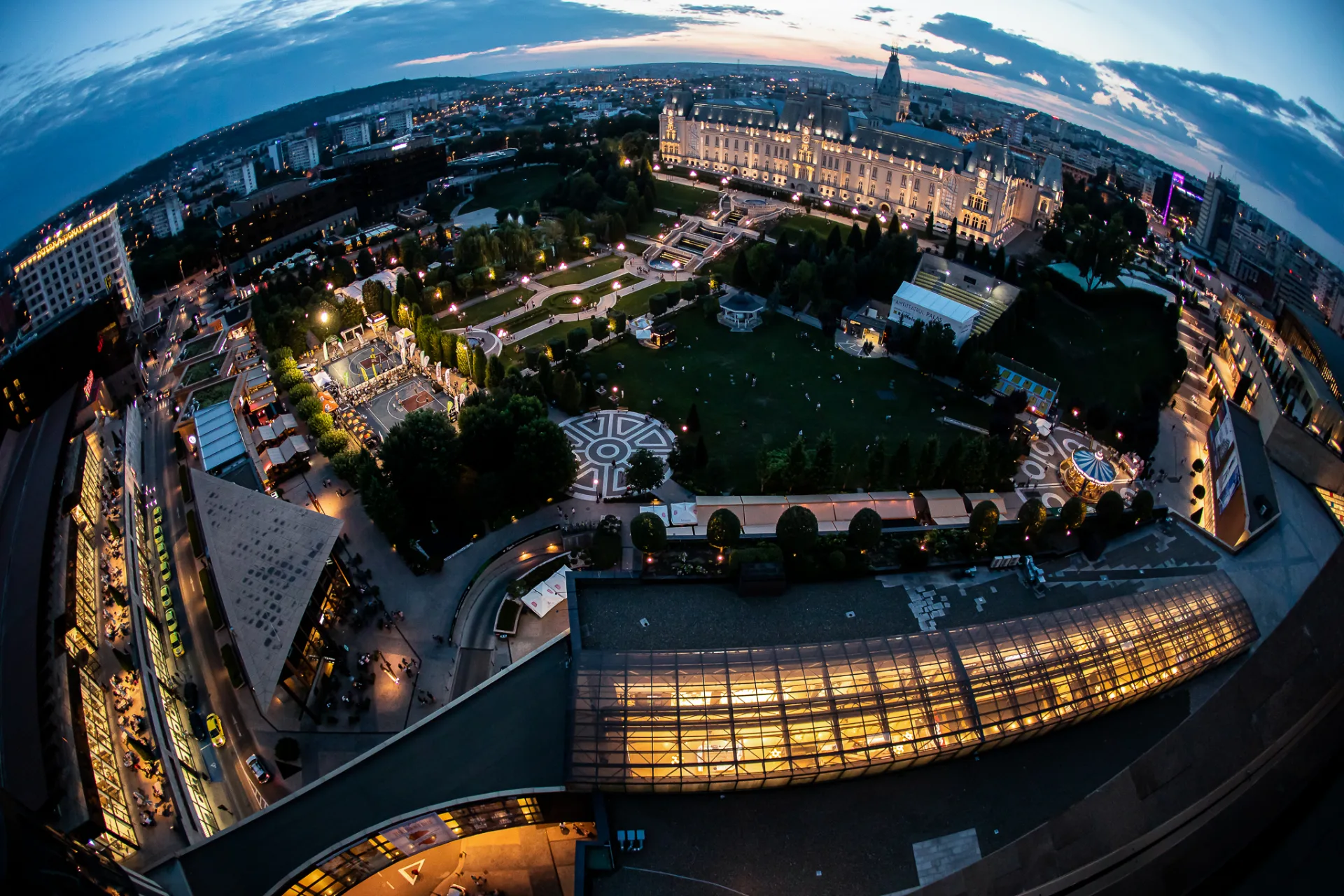
However, the primary shopping destination for Iasi and the broader Northeast region is Palas Iasi, developed by the same visionary investor. Palas Iasi is part of Romania’s most significant urban regeneration projects. It features the renovation of the iconic Palace of Culture, seven United Business Center office buildings, a hotel, an events expo, an open-air theatre, and a 62,000 sqm shopping center. Probably the crown jewel of the Northeast region, the total investment in Palas Iasi stood at 310 million EUR and served as essential infrastructure for the overall economic development. Increasing living standards by offering modern retail, office, and entertainment options, Iasi attracted the second youngest workforce after Bucharest. In addition, a steady number of multinational companies provided training and an increased average income, making Iasi a desirable destination not just for university studies but for permanent living.
Iulius Group brought two other concepts to the market. The first one is Family Market, two strip centers located in Iasi’s most dynamic suburban areas (Miroslava and Bucium). The second is the 6,000 sqm commercial area in Palas Campus, a destination for F&B and services to serve the 5,000 employees in the business center.
Other retail schemes in Iasi include Era Shopping Park, a 50,000 sqm retail park located towards the exit to Bucharest. Inaugurated in 2008, Era Shopping Park is anchored by key retailers such as Carrefour, Mobexpert, Rovere Mobili, Brico Depot, Altex, Decathlon, JYSK, Sportisimo, Pepco, Kenvelo, etc. Shopping Park Iasi, opened in 2014 by Square 7, spans 11,000 sqm leased by Flanco, MaxiPet, JYSK, and Kik. In addition, the 10,000 sqm commercial area in the Silk District that developed in five subsequent phases shall enrich the modern retail offering of the city.
Thus, the total stock of modern retail surpasses the 170,000 sqm threshold. The c.a. 20,000 sqm of modern retail expected on the market should increase the retail density (retail space to 1,000 inhabitants) to 650, an indicator lower than in most other cities in Romania — the number signals room for growth, pending continuous economic development and wage increase. Iasi’s prime shopping center rent is 55 Eur/sqm, whereas retail park rent ranges between 7 to 12 Eur /sqm.
However, there is encouraging news that places faith in the city’s economic prospects. IKEA most recently announced a 24,000 sqm store, its fourth in Romania, opening in Era Shopping Park in 2024. This step confirms that there is a critical mass of young families looking to buy or update property, with an income level matching Western standard.
Iasi office market capitalizes on the talent pool nurtured by the seven universities in the cityhttps://romaniapropertyclub.ro/wp-content/uploads/2024/01/ROMANIA_PROPERTY_CLUB_IASI_OFFICE-scaled.jpg25602560ROMANIA PROPERTY CLUBROMANIA PROPERTY CLUBhttps://romaniapropertyclub.ro/wp-content/uploads/2024/01/ROMANIA_PROPERTY_CLUB_IASI_OFFICE-scaled.jpg
The vision of building the first modern office building in Iasi was the crux of the city’s development. Traditionally, blue-collar jobs set the premises for developing more sophisticated services that require modern infrastructure. However, in the case of Iasi, the pioneering led by the Iulius Group set the premise for the city’s economic development. The group transformed the central area through one of the most significant mixed-use urban regeneration projects in Romania.
Palace Campus, Iasi
Following the bold vision of “build, and they shall come,” Iulius developed the first class A office building in Iasi, United Business Center I – a shy 7,000 sqm in 2010, 15 years later than the first modern Class A office buildings delivered in Bucharest. Fast-forward a decade plus later, Iulius developed 130,000 sqm, representing 50% of the total office stock in Iasi and more than two-thirds of the Class A stock. Its most recent portfolio addition is Palas Campus, a 120 million EUR investment spanning over 54,000 sqm of offices and 6,000 sqm of commercial areas. It is home to Amazon, Microsoft, Cognizant, Expeleo, AMD, Hella, and many others. These reputable companies joined a group of over 70 multinationals that decided to capitalize on the talent pool nurtured by the seven universities in the city.
In addition to the United Business Center and Campus buildings, there are two other notable office developments in Iasi. Moldova Center, the reconversion of a former department store into a functional office building, added 16,000 sqm of GLA in the center of the city. It was fully leased by companies such as Webhelp, Conduent, 3Pillar, and HCL. Tester Group built Ideo Centro (later rebranded as Tester Technology Park), a 25,000 sqm business park hosting KPMG, Tata Technologies, Oracle, and Conduent, among others.
In Iasi, the asking rents range from 12 to 15 EUR/sqm, and the vacancy rate is still in the single-digit range, with a preference to work from the office, as the commute is not as burdening as in Bucharest and the workforce requires more in-person time for training and collaboration. Moreover, people enjoy the modern facilities and sense of community provided by the integrated commercial–office schemes and the apprenticeship that comes from shadowing. However, the low vacancy rate and the limited competition of class A office buildings lead to lower tenant incentive packages than in Bucharest.
Prime Kapital is the second prominent investor who took a leap of faith and embarked on a large mixed-use urban regeneration project in Iasi. Silk District is a large-scale residential and office scheme complimented by 10,000 sqm commercial spaces and a 4 ha private park to serve residents and the neighboring area. The first phase of the BREEAM Outstanding office park (c.a. 104,000 sqm at maturity, 5 buildings) is scheduled for delivery in Q4 2023, after a slight delay from its announced target date. Communication concerning the future tenants is pending.
Iasi to take off in new development stagehttps://romaniapropertyclub.ro/wp-content/uploads/2024/01/ROMANIA_PROPERTY_CLUB_IASI-scaled.jpg25602560ROMANIA PROPERTY CLUBROMANIA PROPERTY CLUBhttps://romaniapropertyclub.ro/wp-content/uploads/2024/01/ROMANIA_PROPERTY_CLUB_IASI-scaled.jpg
Public investments of 1.2 billion EUR and private investments in new, modern, real estate projects of half of billion EUR are transforming Iasi in one of the most important cities on Romania’s investment map.
Iasi
Ongoing public investments:
100 million EUR for the expansion of the airport Terminal 4, with the aim of reaching an annual traffic of 3.3 million passengers.
670 million EUR for Iasi Emergency Regional Hospital.
300 million EUR for Mircesti-Pascani lot from A7 motorway.
PNRR 175 million EUR for city modernization: trams, schools, and old blocks refurbishments.
40 million EUR from EBRD for Dacia tram depot.
Real estate investors such as Iulius, Impact Developer & Contractor, Prime Kapital, plus retailers such as Ikea and Jumbo, also added Iasi to their portfolio.
Iulius finalized this spring a 120 million EUR investment in Palas Campus. Impact obtained the building permit for a major scheme totaling 1,062 apartments on Copou hill. Prime Kapital is developing a mixed-use project on the former Teba industrial platform: 1,549 apartments and 100,000 sqm of class A offices. Jumbo inaugurated a 10,000 sqm unit in October, while Ikea announced Iasi as the third city where it will build a new store in Romania.
The modern office stock counts for 260,000 sqm. The asking rents range from 12 to 15 EUR/sqm and the vacancy rate is still in the single-digit range.
The city is weak in terms of new, modern housing units. Data collected by RPC from imobiliare.ro show that offers for the first three quarters in 2023 total 1,275 apartments, of which the new units listed count for 410, a minus of 18% as compared to the same period of the previous year.
Regarding the retail sector, 20,000 sqm will be added to the existing 170,000 sqm. The broader Northeast region is the least developed in terms of industrial and logistics, representing a mere 2% of the total modern stock.
In the last 10 years, although Iasi hotel tourist arrivals increased by 105% (around 156,000 new tourists), the number of new hotel rooms increased with only 11%. Branded hotels represent only 12% of total rooms capacity and all of them are within “3-star” ranking. There are no 4* or 5* branded hotels in Iasi.
The county hosts 983,506 people, second only to Bucharest. The metro area of the city of Iasi is where more than half of the county’s population resides. The strong base of an educated workforce attracted dozens of reputable multinational companies, transforming Iasi in Romania’s Silicon Valley.
The proximity to Ukraine and the Republic of Moldova makes Iasi an informal capital for the broader region.
Music, sports, and film festivals reflect in Romania’s highest hotel pipelinehttps://romaniapropertyclub.ro/wp-content/uploads/2024/01/ROMANIA_PROPERTY_CLUB_CLUJ-NAPOCA_HOTELS-scaled.jpg25602560ROMANIA PROPERTY CLUBROMANIA PROPERTY CLUBhttps://romaniapropertyclub.ro/wp-content/uploads/2024/01/ROMANIA_PROPERTY_CLUB_CLUJ-NAPOCA_HOTELS-scaled.jpg
In the last 10 years, Cluj-Napoca’s hotel market registered the highest increase in Romania at “5-star” category with 613 new rooms, as the data gathered by RPC from tourism consultancy company Est Hospitality show. In Bucharest only 534 new rooms were developed at the same category.
Cluj-Napoca
The total number of new hotel rooms from Cluj-Napoca increased with 36%, representing 730 new rooms. The highest increase of 411% is in the “5-star” ranking (613 new rooms), followed by “4-star” category with 31% (221 new rooms).
RANKING
2023
2014
2023 vs 2013 Hotels
Hotels
Rooms
Hotels
Rooms
5*
7
762
2
149
411%
4*
18
932
15
711
31%
3*
23
960
23
885
8%
2*
3
81
6
266
-70%
1*
1
6
0
0
Total
52
2741
46
2011
36%
Branded hotels in the market represent 20.3% from total capacity and most of them have more than 100 rooms. Double Tree by Hilton, Radisson BLU, Ramada, Golden Tulip Ana Dome, Hampton by Hilton are the five brands present locally, totaling 558 rooms.
Regarding tourists’ arrivals by hotel ranking, Cluj-Napoca registered the highest arrivals in the “4 – star” and “3 – star” hotels. In 2022, the arrivals in hotels units from Cluj-Napoca are still 13% lower than in 2019. Only at “4-star” hotels in 2023 we estimate the arrivals will be higher than in 2019.
In the next three years there are four hotel projects in pipeline with a total number of rooms of around 600 new rooms representing a growth of 22% for Cluj hotel market. In the next three years (2024-2026), Cluj-Napoca has the highest hotel development pipeline from Romania.
NB
BRANDED HOTELS PIPELINE
NUMBER OF ROOMS
RANKING
HOTEL GROUP
OPENING YEAR
1
Courtyard by Marriott
100
4*
Marriott
2024
2
Branded hotel & residences
243
4*
International
2026
3
Ibis Styles
110
3*
Accor
2025/2026
4
Independent hotel
140
4*
Independent
2026/2027
TOTAL
593
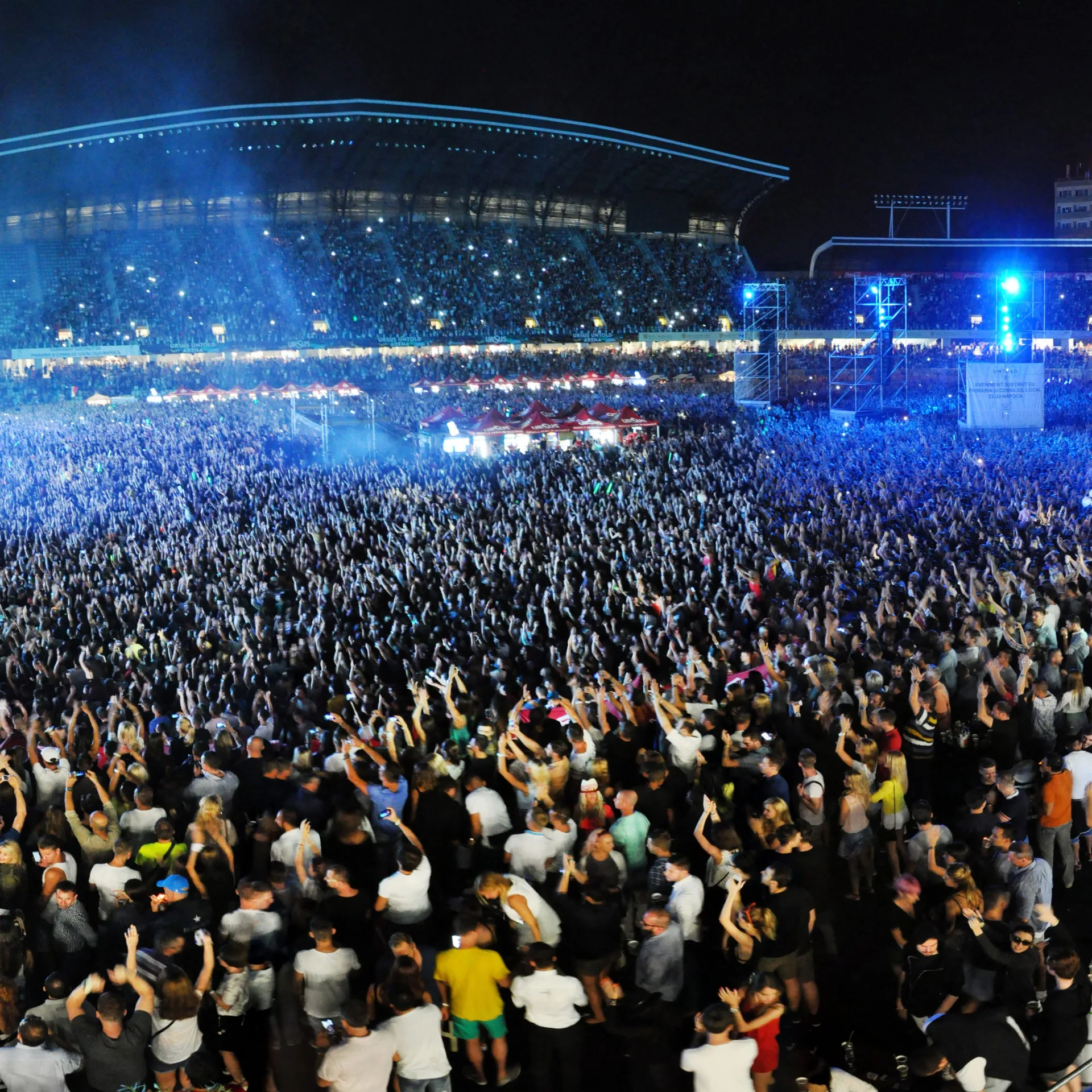
“The number of new hotel projects is a very good sign of confidence in the market growth over the next three-four years. A demand driver that has a direct impact on the market is the development of the city as an IT hub and a calendar of international festivals (ie.: Untold, Electric Castle, etc)” Mircea Draghici, Managing Partner, Est Hospitality.
The world-class economic development is sustained by modern working infrastructure. The total stock of Class A office buildings in Cluj is 340,000 sqm, with expected future deliveries of 75,000 sqm.
Cluj-Napoca
Headline rents for prime Class A properties range between 13.5 to 15 EUR/sqm. While the vacancy rate (6%) indicates a landlord’s market, it is important to note that since the work-from-home switch, the total market activity was a fraction of Timisoara’s, registering only 9,400 sqm in 2022 and 5,900 sqm in H1 2023. Moreover, there is a growing number of companies looking to sublease.
On the one hand, the work-from-home/hybrid model coupled with pricy residential led younger professionals to relocate with families in the neighboring counties, thus decreasing the utilization rate of the office. On the other hand, companies are aware of the limited new supply, as the majority of the pipeline is foreseen to materialize in more than 24 months, geographical constraints of Cluj-Napoca in lack of a developed metro infrastructure, and vivid memories of the race to secure space in line with exponential growth in a tight market. Moreover, companies have done further hiring over the past few years and expect the office as is to become right-sized even in a hybrid work world.
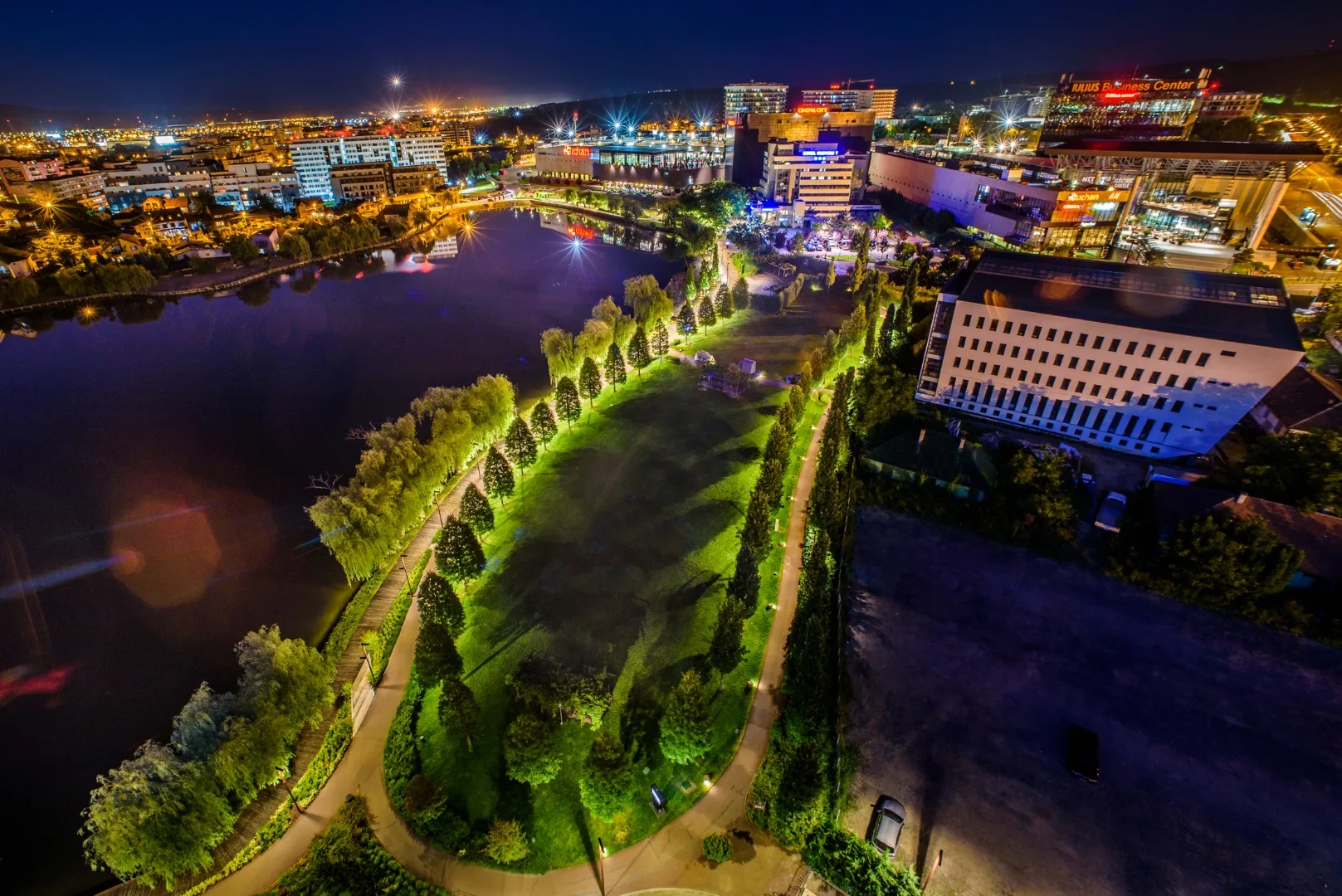
Iulius put its toll on Cluj, following the same transformative mixed-use urban regeneration strategy applied in Iasi and Timisoara. The office component, under the United Business Center umbrella, features three separate projects built in 2008, 2014, and 2018, totaling 27,000 sqm, with future development possibilities for UBC Riviera. Companies that chose to work in UBC buildings include Endava, Genpact, Office Depot, and Analog Devices.
The Office is one of the emblematic business parks in ultra-central Cluj-Napoca. The 60,000 sqm of office and retail were built by Mulberry Development and Nepi Rockcastle custom to Cluj-Napoca market needs. As this was an accelerated growth market, the business park was constructed in three phases between 2013 and 2017 with the end goal of delivering a 9,000 sqm united floor plate, that could host up to 1,000 employees on a single level. As the metro project is years in the making, The Office concept features 1,100 car parking spaces and up to 400 bicycle/motorbike racks. The modern amenities, 200 seats capacity conference center, and visually appealing landscaping serve community building purposes for companies such as Deloitte, Yonder, 3Pillar Global, Bombardier, Betfair, Steelcase, National Instruments and Bosch. In 2019, Paval Holding added the landmark property to their portfolio for c.a. 130 million EUR.
Hexagon Offices is a Class A business complex delivered in mid-2019 by a joint venture between local entrepreneurs who managed to secure top-tier tenants such as Cognizant and Accenture. It exchanged hands for 32 million EUR at the end of 2019, being taken over by a Romanian family business.
Belgian Speedwell performed its first development outside Bucharest – a mixed-use residential and office development named Record Park. The 236 apartments were immediately sold out, whereas the 12,000 sqm of offices were occupied by EON, Mass Mutual, or MHP Porsche. It scheme is completed by co-working (Stables) and a large World Class leisure facility.
The above-mentioned schemes are a select few brand-new Class A projects that support the economic development of Cluj-Napoca. Cluj Business Campus, Liberty Business & Technology Park and legacy projects such as Maestro BC, Amera Tower, and City Business Center are a couple of other notable locally developed offices that served the needs of the city.
It is important to note that Cluj proved itself to be the most liquid market outside Bucharest, with major office sales over the past five years totaling 260 million EUR (10% compared to Bucharest, 3x compared to the third-ranked – Timisoara), marking exits to either local investors confiding in the market’s strength or potent national and international investors.
Moving forward, the future looks bright for Cluj-Napoca. While the immediate pipeline is for approx 7,000 sqm (new phases of Liberty Business & Technology Park), two of the most impactful investors in Romania made plans to deploy more than 850 million EUR over the next 5-10 years in Cluj-Napoca. Iulius and Prime Kapital, in partnership with MAS Group committed to the reconversion of 14, respectively 17 ha of conveniently located industrial platforms – Carbochim and Cesarom. The first phase of the office component of the new Iulius Group is 15,000 sqm GLA, whereas the total office component for Cesarom is 49,000 sqm. Further development is limited only by the capacity to cross the finish line of the metropolitan train and underground projects.
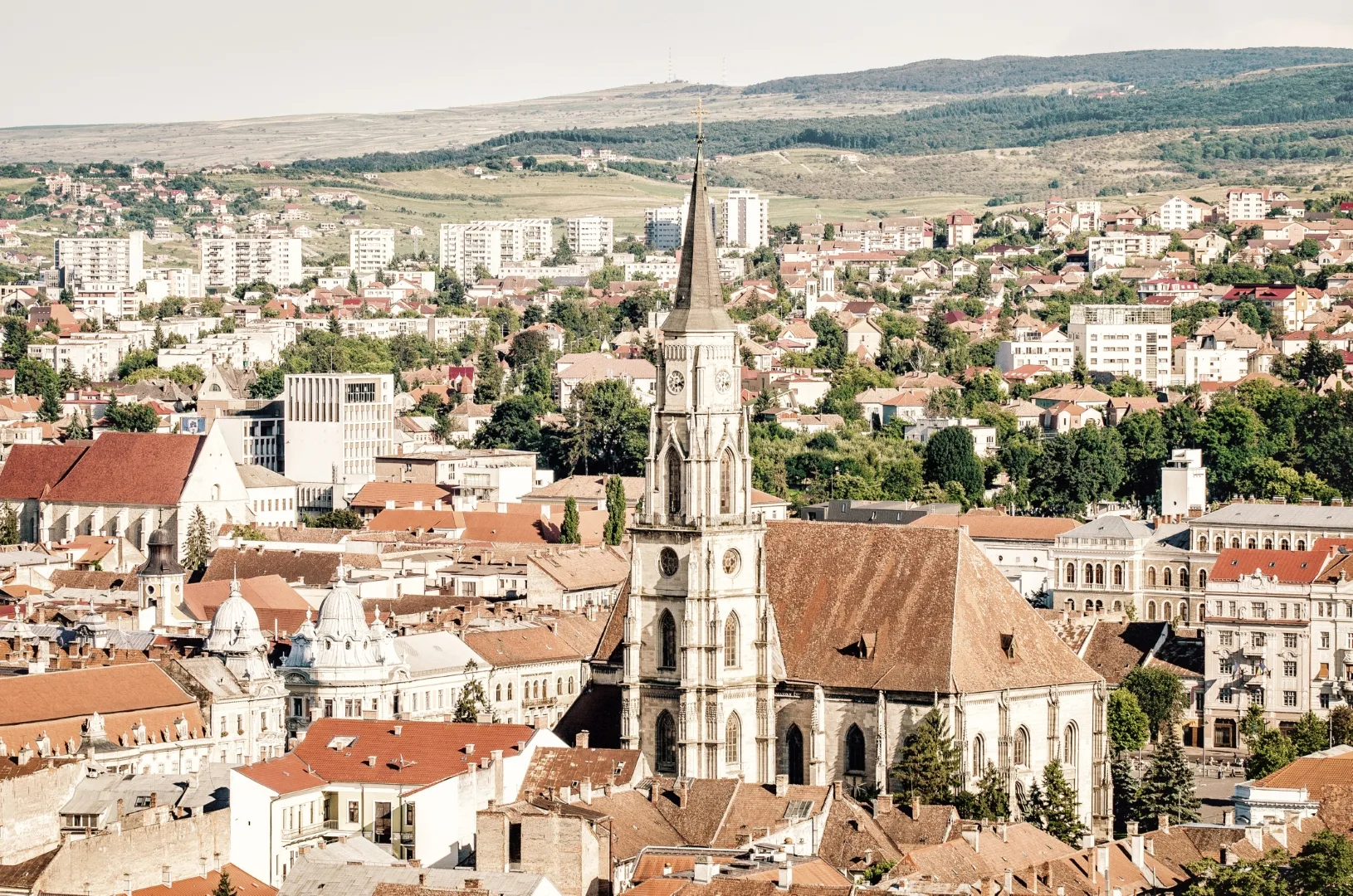
Public infrastructure investments doubled by a reach calendar of events determine a flamboyant business environment in Cluj-Napocahttps://romaniapropertyclub.ro/wp-content/uploads/2024/01/ROMANIA_PROPERTY_CLUB_CLUJ-NAPOCA.jpg16301080ROMANIA PROPERTY CLUBROMANIA PROPERTY CLUBhttps://romaniapropertyclub.ro/wp-content/uploads/2024/01/ROMANIA_PROPERTY_CLUB_CLUJ-NAPOCA.jpg
Cluj’s economic strength does not rely on a single champion or sector. In addition to the technology, cultural and financial examples with Romanian capital and leadership, companies as diverse as construction materials (Cemacon), textiles (Jolidon), consumer goods (Farmec), infrastructure (E-Infra/Electrogroup), or recycling (Rematinvest) speak of a truly performant region, able to pioneer generation to generation.
Cluj-Napoca
Right now, authorities are working on one of the most important infrastructure investments – a new metro line. The new project is expected to redesign new interest hubs regarding the local land market. According to local consultancy company Simon, Iuga & Partners, prices for permitted plots vary between 80-120 EUR/sqm for logistics development, 225 – 400 EUR for retail developments and 1,000 – 2,000 EUR/sqm for mixed-use (residential & retail) developments.
The world-class economic development is sustained by modern working infrastructure. The total stock of Class A office buildings in Cluj is 340,000 sqm, with expected future deliveries of 75,000 sqm. Iulius and Prime Kapital, in partnership with MAS Group committed to the reconversion of 14, respectively 17 ha of conveniently located industrial platforms – Carbochim and Cesarom. The first phase of the office component of the new Iulius Group is 15,000 sqm GLA, whereas the total office component for Cesarom is 49,000 sqm.
Cluj-Napoca continues to be the most high-priced residential market nationwide, in the context of low levels of new offers. Data from real estate platform imobiliare.ro for August indicate that the residential medium price per sqm is 2,452 EUR in Cluj-Napoca, much higher than the one asked in the Capital City.
The retail density of 522 sqm per inhabitant is quite low compared to the accelerated economic development and the city’s appeal to youth. It represents a testament to the difficulty of building due to geography.
Cluj registers a well-rounded modern stock of industrial and logistics facilities, reaching more than 420,000 sqm. Cluj has a long history of industrial production, particularly heavy machinery, and construction materials, with a well-developed manufacturing & logistics infrastructure.
Music, sports, and film festivals reflect Romania’s highest hotel pipeline. In the next three years (2024-2026), Cluj-Napoca has the highest hotel development pipeline from Romania: 593 rooms.
The region’s future lies in its ability to pivot to the latest technologies and to attract the right talent.
We use only essential cookies by default. With your consent, embedded YouTube videos may also set cookies. You can change your choice at any time from “Cookie settings” at the bottom of every page. Read our Cookie Policy.