In central Constanța, on the site of the former Oil Terminal platform, real estate developer IULIUS has launched the largest bioremediation project ever undertaken by a private investor in Europe.
The soil remediation phase represents an investment exceeding €29 million. It marks the second stage—following extensive archaeological surveys—of a broader €800+ million urban regeneration initiative aimed at transforming 38 hectares of contaminated industrial land, left idle for over a decade, into a vibrant, mixed-use district.
HISTORICAL CONTEXT
The site carries a heavy industrial legacy: for nearly a century, it housed an oil storage depot featuring more than 30 petroleum product tanks. Given the age of the facilities and the site’s proximity to the city center after eight decades of operation, traditional mechanical remediation was no longer viable.
The breakthrough came from Romanian scientific research. Specialists at the National Research and Development Institute for Soil Science, Agrochemistry and Environmental Protection (ICPA Bucharest) developed a proprietary formula using natural microorganisms isolated directly from the contaminated soil to biodegrade petroleum hydrocarbons. The non-genetically modified bacterial strains pose no risk to human health or the environment, leveraging an enhanced natural degradation process to significantly shorten the site’s recovery timeline.
THE THREE-STAGE BIOREMEDIATION PROCESS
The entire process is being conducted fully on-site through three distinct phases:
- Soil Bioremediation: Excavated earth is sorted, processed, and arranged into biopiles—structured mounds mixed with compost and organic fertilizers. These are inoculated with the selected microorganisms and maintained under optimal moisture, temperature, and aeration conditions.
- Contaminant Isolation: A high-density geomembrane lines the base of the excavation, physically preventing any horizontal or vertical migration of pollutants.
- Groundwater Treatment: A hydrogeological barrier consisting of perimeter wells diverts contaminated groundwater to an on-site treatment facility. The purified water is then recycled for safe operational uses, such as site cleaning and green space irrigation.
INTEGRATED MULTIDISCIPLINARY EXPERTISE
The project brings together top-tier international and domestic expertise. Dr. Anca-Rovena Lăcătușu, Head of Laboratory at ICPA Bucharest, developed the bio-inoculum technology. Water treatment operations are handled by Hoelscher Wasserbau, a leading German environmental engineering firm with over 60 years of industry experience. Engineering design was overseen by Auditeco, led by Cicerone Ionescu, bringing nearly three decades of expertise in environmental compliance and remediation.
To scale the technology, IULIUS invested over €420,000 in research infrastructure:
- ~€300,000 to equip an ICPA laboratory dedicated to microorganism cultivation.
- ~€120,000 to establish a chemical analysis laboratory at Ovidius University in Constanța.
VISION: “CONSTANȚA 365”
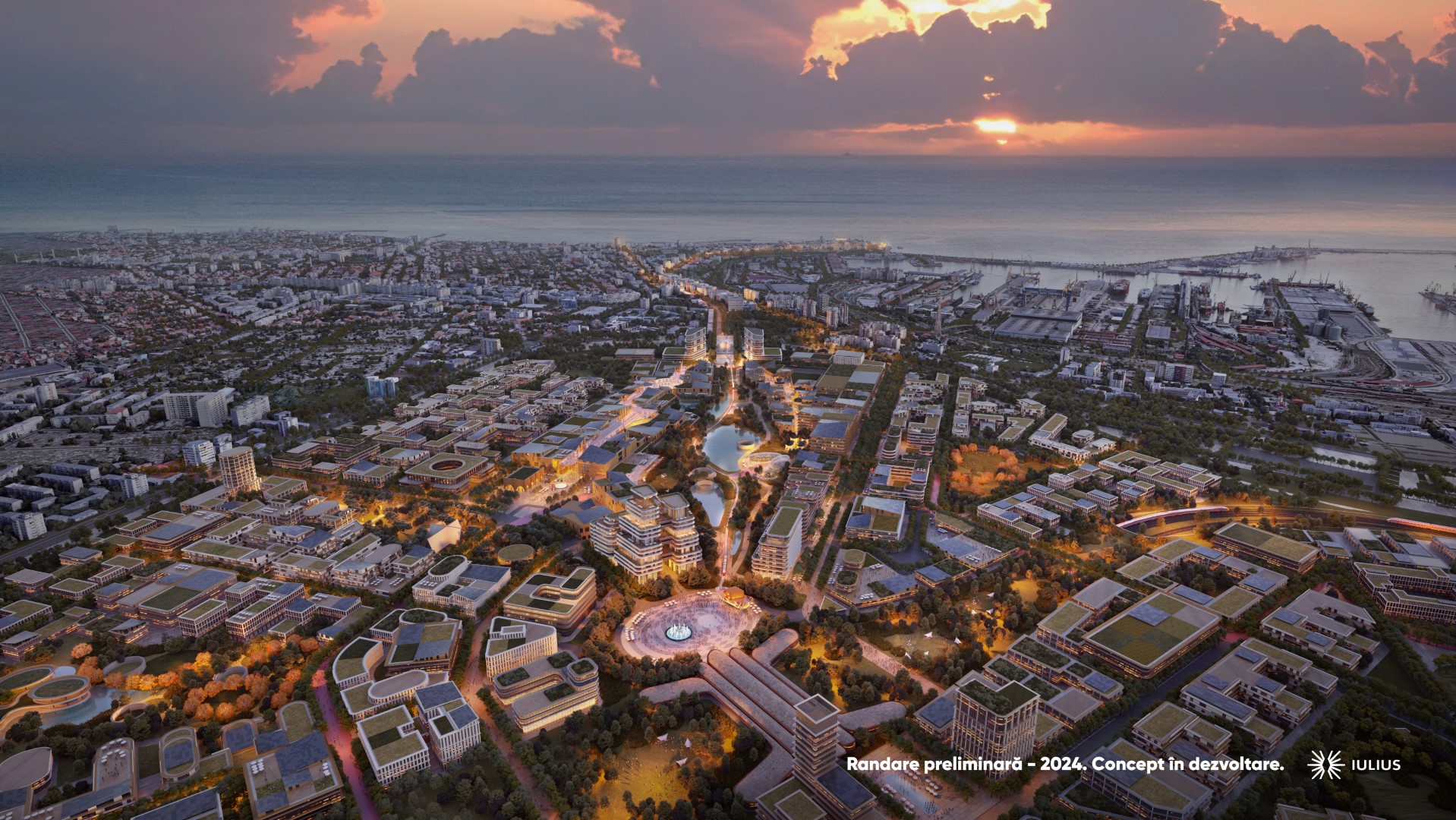
Beyond environmental restoration, the ultimate goal is urban transformation. IULIUS is advancing Romania’s largest urban regeneration concept—a mixed-use master plan designed by world-renowned architecture firm Foster + Partners to establish Constanța as a year-round destination.
The development will feature cultural and educational venues, retail, office space, entertainment, sports facilities, and a central park with a botanical garden (supported by Dobrogea’s first dedicated tree nursery, where over 1,100 mature trees have already been acclimatized). The master plan also prioritizes sustainable mobility through extensive pedestrian, cycling, and road networks.
Under the tagline “Nature works. Science helps. Constanța wins,” the initiative sets a benchmark for industrial brownfield redevelopment—converting a decades-old environmental liability into a safe urban asset while paving the way for similar soil restoration projects across the region.